What to do if your flight from — or through — the Middle East is affected this week

Editor's Note
If you're traveling from or through any airport in the Middle East this week, you're likely dealing with travel disruptions and cancellations.
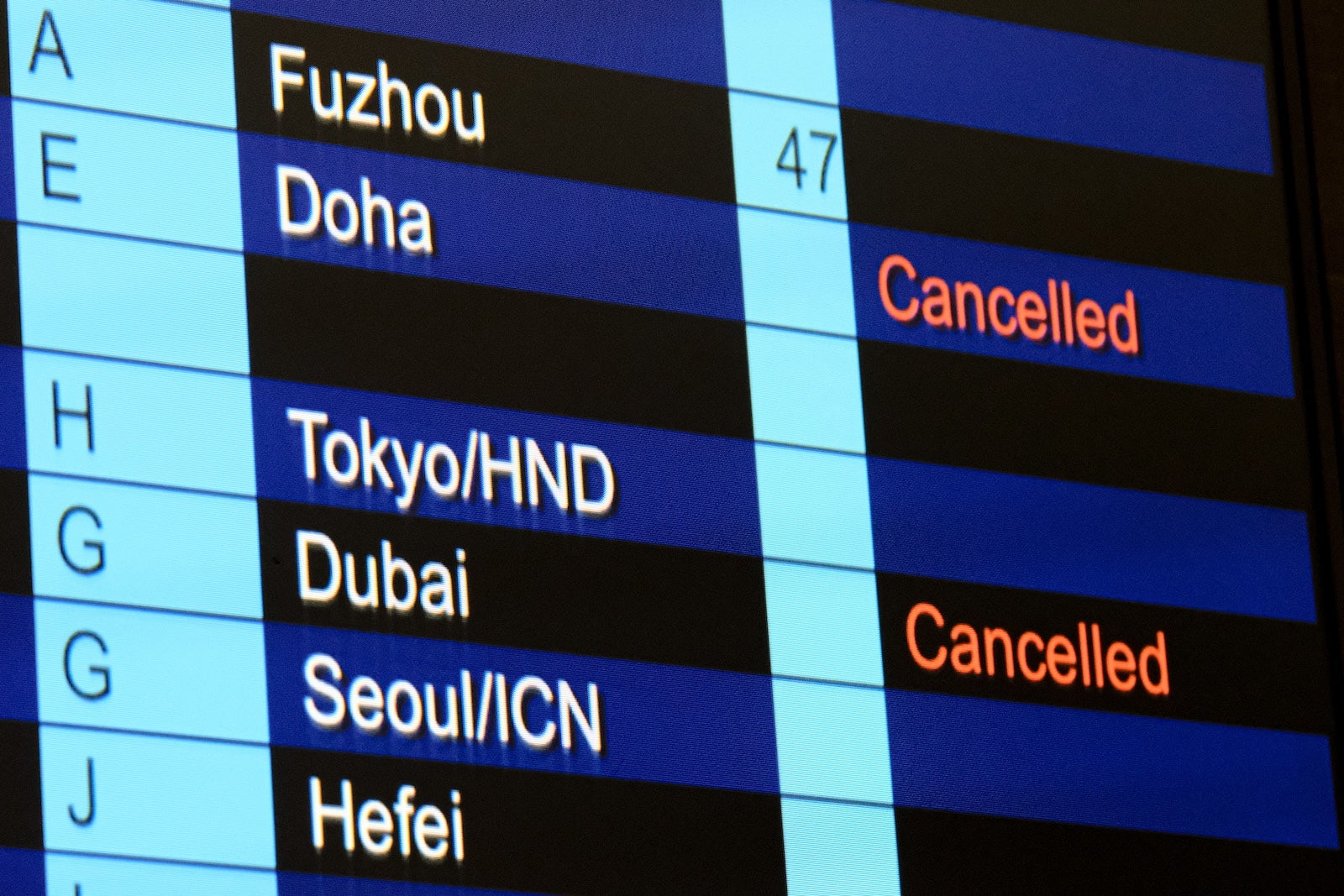
Early Saturday morning, the U.S. and Israel launched missile strikes on Iran, and Iran retaliated with its own strikes against not only Israel but also multiple U.S. allies in the region, including the United Arab Emirates. Airspace and airports were closed throughout the region over the weekend; affected airports included two of the world's busiest international airports, Dubai International Airport (DXB) and Doha's Hamad International Airport (DOH).
Although some airports and airlines have resumed limited service, more than 11,000 flights have been canceled so far, affecting travelers in the Middle East and beyond.
The U.S. Department of State is urging all Americans to depart from this list of more than a dozen countries immediately. However, many of these countries do not currently have fully operational airports or flight availability.
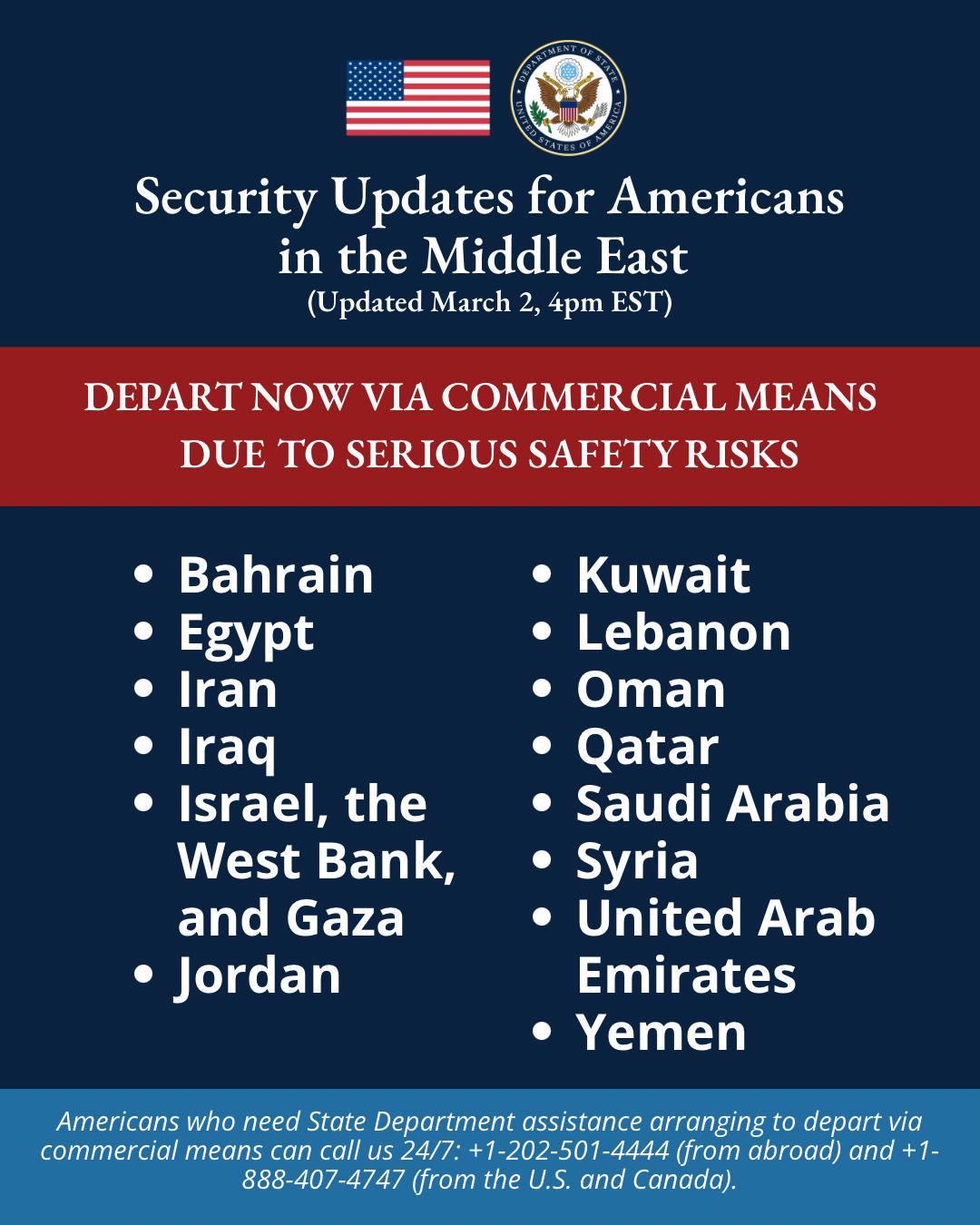
While some countries — including France, Germany, Italy and the United Kingdom — are chartering repatriation flights, the U.S. is currently advising Americans to find commercial flights home.
Here's a guide on what to do if you are currently affected by the global travel crisis.
What to do if you're stranded in the Middle East right now
"It is critical to adhere to all official directives amid renewed Iranian attacks and military activity. Travelers should be prepared to stand fast in a secure location for an extended period," Healix International, a global risk assessment company, said in a statement to TPG. "Travelers should monitor the viability of outbound travel and remain aware of the operational status of airports throughout impacted countries."
As of Tuesday, March 3, DXB and Abu Dhabi's Zayed International Airport (AUH) have reopened with limited airport operations for a small number of flights. However, DOH remains closed.
We recommend registering for the Smart Traveler Enrollment Program. STEP is a free service for U.S. citizens and nationals that allows you to enroll your trip abroad so the U.S. Department of State can quickly and accurately contact you in case of an emergency at your travel location. Once you are enrolled, you will receive updates and alerts regarding next steps.
Related: How the State Department's Smart Traveler Enrollment Program could help you on your next trip abroad
Also, ensure your travel documents are ready in case you have the opportunity to depart sooner than expected.
For the thousands of travelers stranded in Qatar and the UAE, there is some reprieve: This week, both governments announced that they will cover travelers' hotel and meal costs while they are stuck in the respective countries.
What to do if your flight is canceled or delayed
Unfortunately, massive flight cancellations are likely to continue across the region this week. On Monday, more than 80% of flights scheduled to and from Dubai and more than half of the flights to and from Abu Dhabi were canceled, according to flight tracking site FlightAware. Qatar Airways posted a statement on X that it will provide an update on flights from Doha, where airspace remains closed, on March 4 at 9 a.m. Also on X, Emirates stated that it expects to resume flights on Wednesday, March 4, at 11:59 p.m.
You may also find that flights from Asia and Africa, which often route through the Middle East, are affected. This happened to TPG editor Mackenzie Roche, who found herself stranded in Hanoi, Vietnam, on Saturday night after Qatar Airways canceled her connecting flight home through Doha. She eventually made it back to New York on Monday morning after rebooking a new flight with three layovers via Hong Kong; Taipei, Taiwan; and Los Angeles.
Related: Flight canceled or delayed? Here's what to do next
Whether you are currently stuck in the Middle East or struggling to figure out how to rebook a return flight that was routed through a Middle Eastern airport this week, your best bet is to contact your airline before heading to the airport. If your flight is delayed or canceled this week, you should be able to receive a travel waiver from your airline to easily change your original flight or cancel and request a refund.
The details and dates of each airline's waiver vary, but you can find additional information on each carrier's website:
- Air France
- American Airlines
- British Airways
- Delta Air Lines
- EgyptAir
- El Al
- Emirates
- Etihad Airways
- KLM
- Lufthansa
- Oman Air
- Qatar Airways
- Royal Jordanian Airlines
- Turkish Airlines
- United Airlines
- Virgin Atlantic
To rebook your flight home, it's best to start with the airline's mobile app, then try calling the call center listed on its website. If neither presents viable options, you can also try reaching out to the airline on X or other social media channels.
TPG's ombudsman, Michelle Couch-Friedman, points out that if you book new flights on your own with a different carrier, it's important to cancel your original booking.
"Airlines sometimes automatically switch you to a new flight, which unfortunately results in you being marked as a no-show for that flight if you haven't canceled," she said. This would prevent you from getting a refund if your carrier is offering one.
The best tools for finding a new route
At this point, if you're trying to get home either from or through any airports in the Middle East, you may wish to consider doing some of the rerouting research on your own, since airlines are dealing with thousands of individual requests.
To start researching, TPG recommends the following options:
- FlightConnections: Provides an overview of worldwide flight routes
- Google Flights: Can also help with routing if you put in your departure airport
- Flighty: Shows flight alternatives when your original flight is canceled
If there are no options with your original carrier, it's also worth asking if there are options on another airline you have researched yourself. Keep in mind that rebooking yourself with another airline is typically not covered by any insurance provider or carrier. But if your original airline's travel waiver covers it, you may be able to get your original ticket refunded, at least.
Other proactive questions to ask your airline when rebooking travel
When rebooking your flights directly through an airline, it helps to be proactive. "Travelers aren't just worried about cancellations, they're asking detailed questions about what benefits may apply," said Chrissy Valdez, senior director of operations at Squaremouth, an online insurance marketplace.
Here are some questions she recommends asking:
- Do my nonrefundable tickets qualify for a waiver or credit to use at a later date?
- Do you work with any partner airlines that may still be operating, and can I transfer my ticket?
Additionally, Squaremouth recommends asking that all correspondence with both the airline and your travel insurance supplier be in writing, in case you need to file a claim.
How to handle current or upcoming hotel reservations in the region
If you have a current or upcoming hotel reservation in a country affected by the ongoing global travel crisis, first check the hotel's website for the latest updates and information about how bookings may be affected. Keep in mind that some properties in the greater region may be actively managing the crisis.
The Points Guy has reached out to several hotel companies for comment. A representative from IHG shared the following with TPG:
The safety and security of our guests and colleagues is always our priority and we hope for an end to the conflict as soon as possible. We are making sure that our hotels and teams across the Middle East have the support they need and where appropriate we are working closely with local authorities. We are also supporting guests wishing to amend their bookings.
Additionally, a representative from Marriott shared this travel advisory message with TPG:
Marriott International is closely monitoring the current regional situation in the Middle East as it evolves. The safety and well-being of our guests, members and associates is our top priority and we are taking all necessary measures in alignment with government authorities and their guidance.
Our hotels in the region remain open and operational and our teams are focused on supporting our guests at this time.
We recommend that guests consult travel advisories from their home government for the most recent guidance and updates before travelling. We also recommend contacting flight providers as there has been some disruption to airspace in the region with flights being cancelled or diverted.
If your travel plans have been disrupted and you are due to stay at a hotel in or travel from an impacted country, any time between 1st March and 6th March 2026, please contact Marriott Customer Support where our teams are able to support 24/7.
Guests who have made bookings via a third-party channel, e.g., a Tour Operator or online travel booking site, should contact their respective booking agent directly for details on their cancellation policies.
In markets experiencing airspace closures or significant flight disruption, hotels are remaining flexible when supporting guests impacted by circumstances beyond their control in terms of cancellations and rebookings.
A representative from Accor shared the following statement:
We are concentrating on our guests, employees and partners that remain the utmost priority. As the situation continues to evolve, we are closely monitoring developments and taking all necessary precautionary measures in coordination with the relevant authorities. Concerning your request, we respectfully decline at this time. We are not making any public statements or providing interviews on the current geopolitical situation.
What does travel insurance cover?
"Unfortunately, war is one of the things most travel insurance policies specifically exclude, whether declared or undeclared," InsuranceQuotes analyst Michael Giusti said. "So you aren't going to be able to get help on that front."
"Most of the airlines are going to work to redirect and reroute travelers, but with airspace closed, there is only so much they can do," Giusti continued. "If the flight is still scheduled to go, but you choose not to take it, that might be a wise call, but that also wouldn't be covered by travel insurance, because fear of travel is never covered."
Couch-Friedman echoed this.
"The reality is that travelers will need to set their expectations low as to what will be covered in this terrible situation," she said. "Of course, the most important thing is safety, but getting out of there ASAP is going to be expensive and probably not reimbursable. So if travelers can find a safe place to wait it out until the airports are open again, that might be the best option."
Another thing to keep in mind, as far as travel insurance is concerned, is that if you book your trip from this point forward, that also would not be covered, "because at this point it is a known event and so no travel insurance policy would cover it," Giusti explained. This is similar to how named weather events, such as hurricanes, are handled.
There are some big exceptions here, though. For example, "cancel for any reason" policies, which would still kick in even in the case of a war, are an option, but they cost more and reimburse at a lower level than traditional policies.
"Just remember, the airline's obligation is to get you another flight," Giusti said. "If you go around it and take another mode of transportation, you would be at the mercy of the airline's cancellation policy."
Though most major credit card issuers offer built-in trip delay or trip cancellation insurance if you purchased your flight with that card, those policies vary widely when it comes to civil unrest or other travel interruptions, so you will need to reach out directly for further information.
Related reading: